Sleepy Cat Nap SVG Design
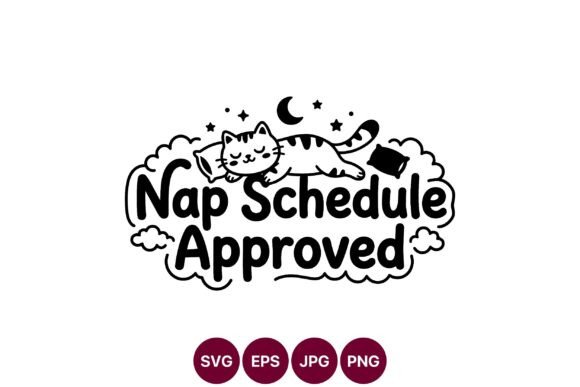
As someone who’s stitched hundreds of designs across apparel, nursery items, and boutique merchandise, I opened the Sleepy Cat Nap SVG Design expecting charm—and got something more: quiet intentionality. This isn’t just a sleeping cat doodle. It’s a cohesive, low-contrast line art composition—black and white, no gradients or shadows—that breathes calm into every curve of the cat’s curled body, every soft edge of the cloud-pillows, and every gentle arc of the crescent moon. The “nap schedule approved” lettering isn’t cutesy; it’s legible at small scale, spaced with breathing room, and integrated like part of the lullaby—not an afterthought.
First Stitch, First Impression: What This Design *Does* for Your Project
I tested Sleepy Cat Nap SVG Design on a medium-weight organic cotton tote bag—exactly the kind I sell at local craft fairs and list on Etsy as “slow living essentials.” When stitched in matte black thread on natural canvas, the design landed exactly as imagined: soothing, uncluttered, and quietly confident. Customers don’t pause to decode it—they smile, relax their shoulders, and say, “That’s *me* after 3 p.m.” That emotional resonance is rare in embroidery files, especially in the Illustrations category. It doesn’t shout. It invites.
The layout is smartly balanced: the cat anchors the center, clouds and stars orbit gently without crowding, and the lettering wraps the lower third like a soft sigh. No element fights for attention. That matters—especially when you’re embroidering on curved surfaces like baby caps or tapered pillow covers. There’s no dense fill stitch cluster to cause puckering, no ultra-thin running stitch that vanishes on terry cloth or fleece. This is a machine embroidery design built for clarity, not complexity.
Where It Shines (and Where to Pause)
Sleepy Cat Nap SVG Design excels in low-stress, high-heart projects: embroidered tea towels for new parents, sweatshirt cuffs for toddler loungewear, minimalist patches for backpacks, or pillow covers for nurseries and reading nooks. Its line-art nature makes it ideal for applique design too—you could easily cut fabric shapes from the outlines and layer them with subtle satin stitch borders.
It performs well on stable, medium-weave fabrics: cotton poplin, twill, linen blends, and midweight knits (with light tear-away stabilizer). On sweatshirts? Yes—but use cut-away backing to prevent shifting during the long nap-themed stitching sequence. On baby onesies? Absolutely—just keep hoop size modest (4x4" works cleanly) and confirm your machine handles fine curves smoothly.
Proceed with care on: stretchy jersey (pre-stabilize aggressively), dark or heavily textured fabrics (test thread contrast first—white-on-navy reads beautifully, but pale gray thread on charcoal may fade), and tiny hoops under 3x3". The stars and smallest cloud details are delicate—not fragile, but best appreciated at 4x4" or larger. Also, avoid cramming it onto curved cap fronts unless you’ve digitized or resized thoughtfully; the lettering flows horizontally and benefits from flat real estate.
Real-World Impact: Beyond the Hoop
This isn’t just about clean stitches—it’s about how the finished product lands with people. A customer buying a personalized gift isn’t evaluating stitch density; they’re feeling whether the item says “I see you.” Sleepy Cat Nap SVG Design delivers that. Its gentle theme builds trust: it signals care, rest, and quiet authenticity—qualities handmade brands need more than ever.
For Etsy sellers and small shop owners, this design supports strong visual consistency. Pair it with neutral thread palettes (oatmeal, slate, ink black, soft white), and it fits seamlessly into a “cozy minimalism” brand story—whether you’re selling embroidered kitchen towels or custom baby blankets. And because it’s delivered as a ZIP folder of scalable vector-based files (typical for Graphics assets), you can generate crisp printable mockups for listings without pixelation.
Practical Designer Notes You’ll Actually Use
- Always test on scrap fabric first—especially if using textured weaves or blending thread colors. Line art reveals inconsistencies faster than fill-heavy designs.
- Check stitch density in your embroidery software. Though not provided in the description, look for smooth transitions between the cat’s outline and cloud contours—no overlapping runs or skipped segments.
- Confirm hoop compatibility. If your project requires tight corners (like a curved apron pocket), verify the design fits comfortably within your most-used hoop size before committing to production.
- Inspect small details at 200% zoom: the tip of the crescent moon, the spacing in “nap schedule approved,” and the separation between stars. These define polish.
- Mock it up in black and white only—no color distractions—to assess balance and rhythm. Does the eye travel softly? Or get stuck?
- Compare light and dark backgrounds using simple digital previews. This design gains warmth on cream, elegance on charcoal, and whimsy on oatmeal.
- Use appropriate stabilizer: light cut-away for knits, tear-away for stable wovens, and optional topping for napped fabrics like terry.
- Verify licensing terms before selling finished items—especially if bundling with other digital assets or offering as part of a commercial embroidery service.
A Design That Rests Well—And Works Harder
What makes Sleepy Cat Nap SVG Design stand out isn’t novelty—it’s restraint. In a market flooded with busy, over-digitized motifs, this design trusts negative space, values readability over ornament, and honors the quiet dignity of rest. It’s equally at home on a holiday embroidery gift for a new mom, a custom embroidered patch for a therapist’s office, or a small shop product line focused on mindful living.
It won’t wow with flash—but it will earn repeat customers, thoughtful tags (“this made me pause”), and slow, steady sales. For embroidery designers and creative entrepreneurs building meaningful handmade products, that kind of reliability isn’t just practical. It’s professional grace.